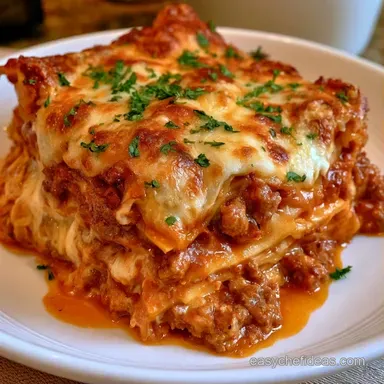
Hearty Beef and Cheese Lasagna

- Prep45 Mins
- Cook1 Hrs 35 Mins
- Servings10 squares
- Time: 45 min active + 1 h 35 min cooking + 20 min resting
- Flavor & Texture: Savory, rich meat layers with a creamy, salty cheese contrast
- Perfect for: Big family dinners or meal-prepping for the week
Hearty Beef and Cheese Lasagna
The sound of beef sausage sizzling in a heavy pot is where this all starts. Using a blend of ground beef and beef sausage gives the sauce a depth that you just can't get from plain mince. It's the heavy lifting that makes the whole dish feel rich and nourishing.
This Lasagna is all about the balance between the bright, acidic tomatoes and the heavy, salty cheeses. You'll see the cheese bubble and brown in the oven, creating those crisp edges that everyone fights over.
It's a comforting meal that feels like a hug in a pan. Just make sure you give it enough time to rest before you cut into it, or the layers will slide apart.
Why it stays structured
Concentrated Sauce: Simmering the sauce uncovered for 45 minutes removes excess water. This means the noodles absorb flavor instead of turning the bottom of the pan into a soup.
Egg Binder: Whisking an egg into the ricotta prevents the cheese from leaking out of the layers during the bake. It creates a stable, set filling that holds its shape when sliced.
The Grocery List
The beef sausage is the hero here. If you use a very lean beef, the sausage adds the necessary moisture to keep the meat tender.
Ricotta provides the creamy contrast to the acidity of the tomatoes. I prefer using whole-milk ricotta because the higher fat content makes the filling feel lush and prevents it from drying out in the 375°F heat.
Fresh parsley adds a tiny bit of brightness to the cheese mixture. Without it, the ricotta can taste a bit flat. It's a small detail that makes the flavors pop.
Precise Measurements
- 1 lb lean ground beef Why this? Provides the hearty base without too much grease
- 1 lb bulk beef sausage Why this? Adds savory depth and herbs
- 1 medium yellow onion, finely diced
- 4 cloves garlic, minced
- 28 oz crushed tomatoes
- 6 oz tomato paste Why this? Thickens the sauce and concentrates flavor
- 1 cup beef broth (low sodium)
- 2 tsp dried oregano
- 1 tsp dried basil
- 1 tsp granulated sugar Why this? Balances the acidity of the tomatoes
- 1 tsp salt
- ½ tsp black pepper
- 15 oz whole-milk ricotta cheese
- 1 large egg, lightly beaten
- ½ cup grated Parmesan cheese
- 2 tbsp fresh parsley, chopped
- ½ tsp salt
- 12 to 15 lasagna noodles Why this? Standard width for a 9x13 dish
- 4 cups shredded low-moisture mozzarella cheese
| Original Ingredient | Substitute | Why It Works |
|---|---|---|
| Beef Broth (1 cup) | Vegetable Broth (1 cup) | Similar salt level. Note: Lighter flavor |
| Ricotta (15 oz) | Blended Cottage Cheese (15 oz) | Similar texture. Note: Slightly tangier |
Gear for the Job
You'll need a 6-quart Dutch oven to brown the meat and simmer the sauce. A large mixing bowl is essential for the cheese blend. Finally, grab a 9x13 inch deep baking dish. If your dish is too shallow, the sauce will bubble over the edges and burn on your oven floor.
Bringing It Together
Stage 1: Preparing the Hearty Sauce
In a 6-quart Dutch oven, brown the ground beef and beef sausage over medium-high heat. Cook until they are deeply browned and hit 160°F (71°C). Add the diced onion and minced garlic, sautéing for 5 minutes until they become translucent.
Mix in the tomato paste, crushed tomatoes, beef broth, sugar, dried oregano, dried basil, 1 tsp salt, and black pepper. Reduce the heat and simmer uncovered for 45 minutes until the sauce thickens enough to leave a trail when drawn with a spoon.

Stage 2: Mixing the Ricotta Filling
In a large mixing bowl, combine the ricotta cheese, beaten egg, Parmesan cheese, chopped parsley, and ½ tsp salt. Stir until the consistency is smooth and uniform. Note: Using pasteurized eggs can lower the risk of foodborne illness in raw mixtures.

Stage 3: Assembling the Layers
Set your oven to 375°F (190°C). Pour 1 cup of meat sauce into the base of a deep 9x13 inch baking dish.
Create the first layer by placing 3 to 4 dry lasagna noodles across the sauce, overlapping them slightly. Spread 1/3 of the ricotta mixture over the noodles, then top with 1 cup of meat sauce and a handful of mozzarella cheese.
Repeat this process twice more to build 3 full layers.
Stage 4: The Baking Process
Finish with a final layer of noodles, the remaining meat sauce, and a generous blanket of mozzarella cheese. Tightly cover the pan with aluminum foil, spraying the underside with oil to prevent the cheese from sticking.
Bake for 25 minutes. Remove the foil and bake for an additional 20–25 minutes until the cheese is golden-brown and bubbling.

Stage 5: The Cooling Period
Take the dish out of the oven and let it sit for 15 to 20 minutes. This allows the structure to firm up, ensuring you get clean slices rather than a slump.
Problems and Solutions
When your Lasagna is watery, it's usually because the sauce didn't reduce enough. If you see a pool of liquid after slicing, the noodles likely released water or the sauce was too thin.
Another common issue is hard noodles. Since we use dry noodles, they rely on the moisture from the sauce to cook. If the sauce is too thick or the foil wasn't tight, the noodles won't soften.
Fixing a Watery Center
The sauce is the main culprit. If it looks "splashy" while simmering, keep it on the heat.
Dealing with Hard Noodles
Ensure the foil is sealed tight. The steam trapped inside is what actually cooks the dry pasta.
Preventing Sticking
Always grease the foil. Otherwise, you'll pull off the top layer of cheese when you uncover the dish.
| Problem | Root Cause | Solution |
|---|---|---|
| Watery layers | Sauce not reduced enough | Simmer sauce 10-15 mins longer |
| Hard noodle edges | Exposed to air during bake | Ensure noodles are covered by sauce |
| Layers sliding | Cut too soon after baking | Let rest for full 20 minutes |
Keeping It Fresh
Keep any remaining portions in an airtight container and refrigerate for 3 to 4 days. As noted in the USDA food safety basics, perishable foods should be cooled quickly.
For reheating, microwave individual slices for 2 minutes, or place the entire tray, covered in foil, into a 350°F (175°C) oven. Warm to an internal temperature of 165°F (74°C).
You may also freeze your Lasagna before it is baked. Wrap the uncooked dish in two layers of foil and store in the freezer for 3 months. To cook from frozen, preheat your oven to 350°F (175°C) and bake for 2 hours, until the centre reaches 165°F (74°C).
Pairing Ideas

Because this meal is quite decadent, it pairs well with something bright to balance the richness. A fresh garden salad tossed in a zesty dressing is an ideal accompaniment. For a warm side, serving toasted garlic bread provides the perfect way to mop up the remaining sauce.
Creative Twists
For a lower-calorie option, substitute some of the pasta sheets with thinly sliced eggplant or zucchini. Just remember to salt the vegetables first to draw out excess water, preventing the dish from becoming too runny.
For a different taste, try Butternut Squash Lasagna Rolls if you want something less meat-centric and more suitable for autumn.
You can also fold a handful of raw spinach into the ricotta mixture. It will wilt perfectly while baking, adding nutrition and a pop of color to the cheese layers.
High Sodium Levels
1110 mg of sodium per serving (48% of daily value)
The American Heart Association suggests limiting sodium intake to 2,300 mg per day
Ways to Lower Sodium
-
Swap the Sausage
Use more lean ground beef instead of bulk sausage, seasoning it yourself to avoid the salts found in processed meats.
-
Limit Added Salt
Cut back on or completely omit added salt from both the ricotta cheese and the meat sauce.
-
Low-Sodium Canned Goods
Select crushed tomatoes and tomato paste labeled no-salt-added to lower the base sodium levels.
-
Moderate the Cheese
Use smaller quantities of mozzarella and Parmesan, or opt for a lower-sodium cheese alternative.
-
Boost Aromatics
Add more fresh garlic, dried basil, and oregano to create a bold flavor that compensates for less salt.
Good to Know
Why did the lasagna fall apart and look watery when cut?
Insufficient sauce reduction or cutting too soon. Simmering the sauce for 45 minutes is necessary to remove excess water. Letting the dish rest for 15 to 20 minutes after baking allows the starches and proteins to set.
What is the right order to layer lasagna?
Start with meat sauce, followed by noodles, ricotta, sauce, and mozzarella. Repeat this sequence for three full layers. Finish with a final layer of noodles, the remaining meat sauce, and mozzarella cheese.
How to make lasagne step by step?
Cook the beef and sausage until browned, then simmer with tomatoes for 45 minutes. Stir together the ricotta, egg, and Parmesan, layer the mixture in a 9x13 dish, then heat for 45-50 minutes at 375°F (190°C). Let the dish rest before slicing.
Can it be assembled ahead, refrigerated or frozen, and baked later?
Yes, you can prepare the dish in advance. Store the assembled lasagna in the refrigerator until baking. Because it contains cooked meat and dairy, it must be kept refrigerated.
Beef and Cheese Lasagna with Ricotta