The Ultimate Make Ahead Breakfast Casserole

- Effort/Time: 20 minutes active prep / 1 hour 5 mins total.
- Flavor Hook: Smoky bacon crunch meets a velvety, sharp cheddar-infused custard.
- Perfect for: Low-stress holiday brunches, high-protein meal prep, or grab-and-go weekday mornings for this amazing breakfast casserole.
- Master the Ultimate Smoky Bacon and Sharp Cheddar Breakfast Casserole
- The Culinary Physics of Custard Stability and Starch Hydration
- Precision Metrics for the Ultimate Morning Crowd-Pleaser
- The Alchemy of Umami: Selecting High-Quality Elements
- Essential Thermal Tools for Consistent Heat Distribution
- The Step-by-Step Architecture of a Flawless Bake
- Navigating Texture Failures and Corrective Culinary Actions
- Flavor Profile Modifications and Dietary Adaptation Strategies
- ⚗️ The Scaling Lab: The Physics of Quantity
- Common Myths Debunked
- Preservation Protocols and Thermal Recovery Methods
- Aesthetic Plating and Flavor Pairing Synergies
- Recipe FAQs
- 📝 Recipe Card
Master the Ultimate Smoky Bacon and Sharp Cheddar Breakfast Casserole
There is nothing more demoralizing than investing in a dozen pasture raised eggs and a pound of thick cut bacon only to pull a watery, gray, and rubbery mess out of the oven. I’ve seen it happen at countless potlucks a breakfast casserole that looks golden on top but hides a reservoir of unevaporated vegetable moisture and weeping egg proteins underneath.
It’s a waste of high-quality ingredients and a total textural failure that leaves the palate feeling coated in grease rather than nourished.
I spent years making the classic mistake of pouring raw egg mixture directly over frozen, moisture laden hash browns, thinking the oven would "fix it." It never did; I ended up with a soggy sponge that lacked any structural integrity.
I realized through repeated failure that the physics of this particular breakfast casserole dish requires independent moisture management for the vegetables and a stabilized emulsion for the liquid base before they ever meet in the baking dish.
The secret to a shattering crust and a velvety interior isn't a "magic" ingredient; it’s starch hydration and controlled protein denaturation. By thawing the potatoes and searing the aromatics in Wright Brand Thick Cut Bacon fat, we create a hydrophobic barrier that prevents the eggs from turning the starch into mush.
This technique ensures every bite of the breakfast casserole delivers a clear, resonant sizzle of crispy potato edges followed by the soft, pillowy yield of a perfectly set custard.
The Culinary Physics of Custard Stability and Starch Hydration
Understanding the molecular behavior of your ingredients transforms a basic breakfast casserole into a professional grade meal. Many people overlook these steps when attempting this specific breakfast casserole.
- Protein Coagulation Control: The inclusion of 1/2 cup heavy cream raises the temperature at which the egg proteins coagulate, preventing them from squeezing out water (syneresis) and becoming rubbery in this popular breakfast casserole.
- Maillard Reaction Optimization: Searing the 1 lb thick cut bacon and onions before baking creates melanoidins, which provide the savory, umami depth that raw-assembled casseroles lack. This is why pre-cooking is essential for a flavorful breakfast casserole.
- Starch Gelatinization: Thawing the 30 oz frozen shredded hash browns allows the surface moisture to evaporate during the initial bake phase, ensuring the potato strands maintain a distinct, toothsome texture rather than dissolving.
- Emulsion Stability: The 1 tsp dry mustard powder acts as a natural emulsifier, helping the fat from the 2 cups sharp cheddar cheese integrate seamlessly into the milk and egg base of the breakfast casserole.
Precision Metrics for the Ultimate Morning Crowd Pleaser
This recipe is engineered for consistency across various oven types, focusing on internal temperature and visual cues rather than just a timer. This consistency is why this breakfast casserole is so reliable.
- Yield: 10 servings
- Prep Time: 20 minutes
- Cook Time: 45 minutes
- Total Time: 1 hour 5 mins
- Internal Target Temperature: 160°F (71°C) for a safe, creamy set.
The Alchemy of Umami: Selecting high-quality Elements
| Ingredient | Chemical/Physical Role (Science) | The Pro Secret (Why This Matters) |
|---|---|---|
| 12 Large Eggs | Structural protein matrix through heat induced denaturation | Provides the "lift" and binding capacity for the entire build. |
| 30 oz Frozen Hash Browns | Complex carbohydrate base for structural integrity | Why this? Pre-shredded starch provides massive surface area for fat absorption and browning. |
| 1 lb Thick cut Bacon | Lipid source and salt cured flavor enhancer | Why this? Thick cut maintains a "snap" even after being submerged in custard. |
| 1 tsp Dry Mustard | Emulsification agent via plant mucilage | Binds the dairy fats to the egg proteins, preventing an oily surface. |
| 2 cups Sharp Cheddar | Fat-rich flavor carrier with low melt point | Why this? High acidity in sharp cheddar cuts through the richness of the heavy cream. |
Essential Thermal Tools for Consistent Heat Distribution
To achieve the desired results, the tools must provide even heat conduction. I recommend a Le Creuset Heritage 9x13 Stoneware Dish because its high thermal mass prevents the edges from overcooking before the center sets, which is crucial for any successful breakfast casserole.
For the stovetop work, a Lodge 12 inch Cast Iron Skillet is non-negotiable. Its ability to retain heat ensures the bacon renders efficiently and the onions achieve a translucent, jammy consistency without burning.
You’ll also need a KitchenAid Balloon Whisk to incorporate enough air into the eggs, ensuring the breakfast casserole has a light, aerated crumb rather than a dense, leaden texture.
Finally, an Oxo Digital Instant Read Thermometer is the only way to guarantee the center is cooked to precisely 160°F.
The step-by-step Architecture of a Flawless Bake
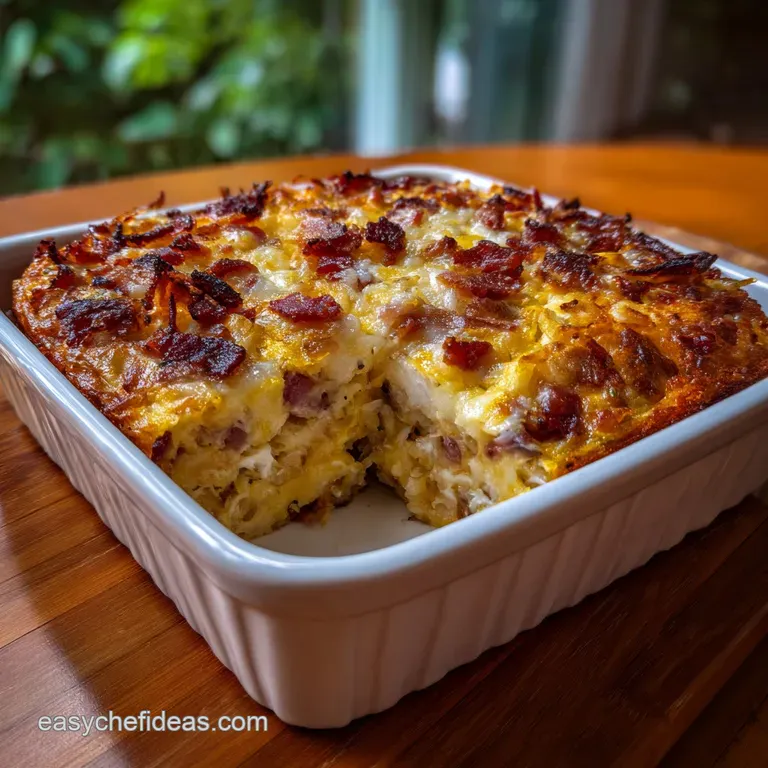
- Thaw the 30 oz frozen shredded hash browns completely by placing them in a colander under cool water or leaving them in the fridge overnight. Note: Excess ice crystals lead to a watery "pool" at the bottom of the dish.
- Dice the 1 lb Wright Brand thick cut bacon into uniform 1/2 inch pieces. Note: Uniformity ensures all pieces reach the same level of crispness simultaneously.
- Sizzle the bacon in a Lodge Cast Iron Skillet over medium heat for 8 minutes until fat renders and edges become mahogany brown.
- Sauté the 1 small yellow onion and 1 red bell pepper in the reserved bacon fat for 6 minutes until the onion turns translucent and the pepper aroma is fragrant.
- Whisk the 12 large eggs, 2 cups whole milk, and 1/2 cup heavy cream in a large bowl until no streaks of yolk remain and the mixture is pale yellow.
- Incorporate the 1 tsp dry mustard powder, 1 tsp smoked paprika, 1/2 tsp Diamond Crystal kosher salt, and 1/2 tsp freshly cracked black pepper into the liquid base. Note: Whisking spices into liquid prevents "clumping" in the final bake.
- Layer the thawed hash browns into the bottom of a greased 9x13 dish, followed by the bacon/vegetable mixture and 2 cups sharp cheddar plus 1 cup Monterey Jack cheese.
- Pour the egg mixture slowly over the layers until the liquid reaches 1/4 inch from the top of the dish.
- Bake at 375°F for 45 minutes until the center no longer jiggles and the top develops a golden brown, bubbly crust.
- Rest the casserole for 10 minutes until the internal steam redistributes, ensuring clean slices of your perfect breakfast casserole.
- Garnish with 2 tbsp fresh chives just before serving for a bright, allium finish.
Navigating Texture Failures and Corrective Culinary Actions
The most common issue with a breakfast casserole is the transition from liquid to solid. If the temperature is too high, the eggs expand too rapidly and then collapse, leading to a "weeping" effect where water separates from the protein.
Why Your Casserole is Watery
When eggs are overcooked, the protein strands tighten like a wrung out sponge, squeezing out the moisture you tried to bake in. This is called syneresis. It’s a failure of temperature management, not ingredient quality, in your breakfast casserole.
| Problem | Root Cause | The Fix | Pro Protocol |
|---|---|---|---|
| Liquid at the bottom | Unthawed/un-drained potatoes | Pat potatoes dry with paper towels before layering. | Use a pre-baked potato crust for 10 mins if you want ultimate crunch. |
| Rubbery egg texture | Oven temperature too high | Reduce heat to 350°F and increase time by 10 mins. | Use a water bath (bain marie) for a delicate, souffle like texture. |
| Cheese didn't melt | Pre-shredded cheese coating | Shred cheese from a block to avoid anti clumping starches. | Mix 1/2 the cheese into the eggs, 1/2 on top. |
Flavor Profile Modifications and Dietary Adaptation Strategies
You can easily adapt this breakfast casserole recipe to suit different palates without compromising the structural integrity of the custard. For example, if you love a sandwich style flavor, you might take inspiration from the Homemade Eggslut recipe and add a layer of caramelized onions and a dash of hot sauce to your breakfast casserole.
| Original Ingredient | Substitute | Why It Works |
|---|---|---|
| 1 lb Bacon | 1 lb & Juicy Homemade recipe sausage | Adds a sage forward, herbaceous note; similar fat content. |
| Whole Milk (2 cups) | Unsweetened Almond Milk | Lowers calories; Note: Result will be slightly less creamy/rich. |
| Sharp Cheddar | Smoked Gouda | Adds a wood fired depth that complements the bacon. |
| Red Bell Pepper | Sautéed Spinach | Adds earthy notes; Note: Must squeeze all water from spinach first. |
⚗️ The Scaling Lab: The Physics of Quantity
When you need to double this breakfast casserole for a large gathering, you cannot simply double everything and expect the same results. That's where many novice cooks fail when attempting to make a double batch of breakfast casserole.
- The Evaporation Paradox: If you double the ingredients into a deeper pan rather than two separate 9x13 pans, the surface area-to-volume ratio drops. This means steam cannot escape as easily. Reduce the milk by 10% to prevent a soggy center.
- Flavor Saturation: Spices like smoked paprika and black pepper should only be scaled to 1.5x. Because they are suspended in a fat-rich custard, their flavor compounds become more potent as the volume increases.
- Thermal Mass & Thermodynamics: A double sized batch in a single large vessel will take significantly longer to reach the 160°F safety zone. The edges will likely burn before the center sets. Protocol: Drop the oven temp by 25°F and use a foil tent over the top for the first 30 minutes.
- Carry Over Cooking: A larger mass retains more heat energy. Pull the breakfast casserole at 155°F; the internal temp will climb to 160°F while resting on the counter.
Common Myths Debunked
- Myth: You must let the casserole sit in the fridge overnight.
Truth: While a make-ahead breakfast casserole is convenient, the "rest" is actually for starch hydration. With hash browns, this happens almost instantly. You can bake this immediately with zero loss in quality.
Myth: Frozen potatoes can go straight into the dish.
- Truth: Frozen potatoes act like ice cubes, dropping the egg temperature and preventing the custard from setting evenly. Always thaw and pat dry before assembling your breakfast casserole.
Preservation Protocols and Thermal Recovery Methods
This dish is a breakfast meal prep powerhouse because the high fat content in the cream and cheese prevents the eggs from drying out during reheating. The leftovers from this breakfast casserole are excellent.
- Fridge Storage: Store in an airtight container for up to 4 days. The flavors of the Christmas breakfast casserole often improve on day two as the spices meld.
- Freezing: You can freeze the baked casserole for up to 2 months. Slice it into individual portions first, wrap tightly in plastic wrap, and then place in a freezer bag.
- Reheating: Avoid the microwave if possible; it makes the potatoes rubbery. Instead, place a slice in an air fryer at 325°F for 5 minutes. This restores the "shatter" to the bacon and the crisp to the potato edges.
💡 ZERO WASTE PHILOSOPHY: Don't discard the bacon fat left in your skillet. Transform: Filter it through a coffee filter and store it in a jar in the fridge.
Science: Bacon fat has a high smoke point and is packed with fat-soluble flavor compounds perfect for searing steaks or roasting Brussels sprouts later in the week. Also, save your chive stems!
Transform: Throw them into a freezer bag for your next vegetable stock. Science: The stems contain the same sulfur compounds as the tips but offer more structural fiber for long simmers.
Aesthetic Plating and Flavor Pairing Synergies
When serving this easy breakfast casserole, contrast is your best friend. The dish is inherently rich, salty, and soft. Pair it with something acidic or bright to cleanse the palate. A simple arugula salad with a lemon vinaigrette or a bowl of macerated berries works wonders.
If you are hosting a full brunch, this savory bake pairs exceptionally well with a blueberry french toast casserole for a "sweet and salty" spread. For a cohesive texture experience, ensure your breakfast casserole with hash browns is sliced with a serrated knife to maintain the integrity of the layers you worked so hard to build.
Similar to the layering logic in a Homemade Tuna Noodle recipe, the goal is to see the distinct strata of potato, egg, and melted cheese in every cross section of this superb breakfast casserole.
Chef's Note: If you want an extra layer of texture, crush a handful of kettle cooked potato chips and sprinkle them over the cheese during the last 10 minutes of baking. The extra salt and crunch provide a "professional finish" that guests always comment on, making this the best breakfast casserole they’ve ever had.
Whether you're looking for breakfast casserole ideas for a busy Monday or a decadent breakfast casserole with bacon for a celebration, the key is the science. Respect the proteins, manage the moisture, and always, always sear your aromatics.
This isn't just a meal; it's a study in culinary balance that will make you the hero of every morning table when serving this magnificent breakfast casserole.

Recipe FAQs
how to make breakfast casserole?
Sear aromatics and pre-cook bacon before mixing with thawed hash browns and liquid egg custard. The initial sauté optimizes flavor via the Maillard reaction, preventing a watery base. For texture refinement similar to layered baked goods, see how the same principle works in How to Bake Cheesy Squash Casserole Delightfully: A Comforting Family Favorite!
how to make breakfast casserole with biscuits?
Use pre-baked, torn biscuit pieces tossed lightly in butter. Biscuits absorb more liquid than bread cubes, increasing the risk of a soggy bottom layer if not partially dried first. Toss the torn pieces with the rendered bacon fat to create a hydrophobic coating before layering.
how to make breakfast casserole with crescent rolls?
Press dough flat against the bottom of the dish and pre-bake for 8 minutes. Crescent dough contains high levels of fat and yeast; pre-baking sets the structure so it doesn't completely liquefy when the egg mixture is added.
This initial bake prevents the dough from absorbing too much moisture, keeping the bottom flaky.
how to make breakfast casserole with potatoes?
Always thaw frozen shredded potatoes completely and squeeze out excess moisture. Frozen water lowers the custard's coagulation temperature, leading to weeping and a rubbery texture upon baking. If you master this moisture control, you master all savory bakes; apply this same focus on water removal to our How to Bake Cheesy Squash Casserole Delightfully: A Comforting Family Favorite!
how to make breakfast casserole with bread?
Use stale or lightly toasted bread cubes for optimal liquid absorption. Fresh bread collapses under the weight of the custard, creating dense pockets, whereas dry starch readily accepts the egg mixture. The toasted edges brown nicely, adding necessary textural contrast to the soft egg base.
What is the internal temperature for doneness?
Target 160°F (71°C) in the center for safety and texture. Heating above this causes protein syneresis, forcing water out of the egg structure, resulting in a dry, rubbery final product.
- Use an instant read probe
- Pull casserole at 155°F (carry over heat finishes it)
- Do not rely solely on visual cues
Myth: Does pre-cooking the bacon matter?
Myth: Adding raw, diced bacon to the egg mixture is fine. Reality: Raw bacon fat emulsifies poorly with the egg/milk, causing an oily layer on top of your finished bake. Searing releases the fat and browns the pork, adding crucial Maillard derived umami.
make-ahead Breakfast Casserole
Ingredients:
Instructions:
Nutrition Facts:
| Calories | 443 kcal |
|---|---|
| Protein | 24.6 g |
| Fat | 29.4 g |
| Carbs | 20.8 g |
| Fiber | 1.8 g |
| Sugar | 4.2 g |
| Sodium | 845 mg |
